

News
Williams Woods Restoration Reaches Major Milestone with Large-Scale Prairie Project
Hits: 708
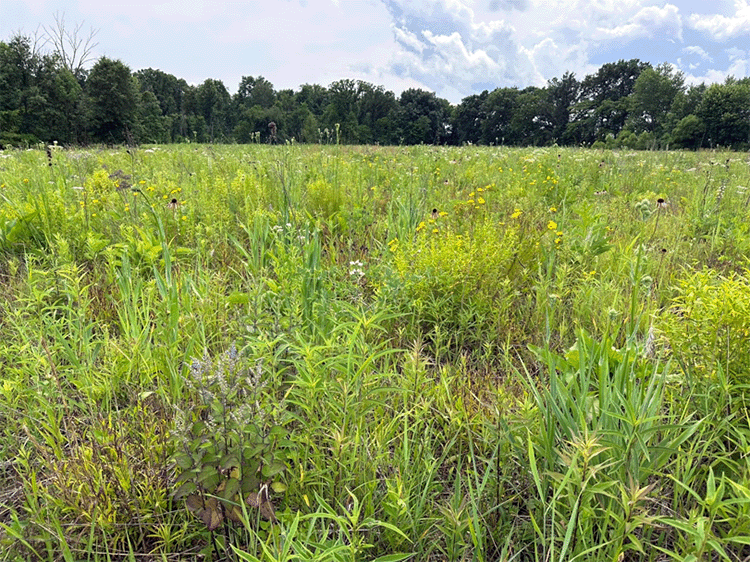
One of the most ambitious habitat restoration projects in NICHES Land Trust's history is entering a transformative new phase.
Following years of planning, stewardship, and partnership, restoration work at Williams Woods Preserve will soon convert nearly 90 acres of former agricultural land into thriving native prairie and thicket habitat, creating one of the largest and most diverse restoration landscapes in west-central Indiana. Located in Warren County, Williams Woods has grown into a 240-acre preserve since NICHES began acquiring the property in 2018. Today, the preserve protects oak woodlands, restored savanna, prairie, and a stretch of Opossum Run, a high-quality gravel-bottom stream.
The preserve expanded significantly in 2024 through a bargain sale from the children of Grover and Millie Williams, adding 120 acres, including about 85 acres of cultivated farmland. Since then, NICHES has leased the cropland while carefully planning its transition back to native habitat, allowing the organization to generate restoration funding while preparing the site for one of its most significant ecological projects to date.
"This restoration represents years of thoughtful planning," said Bob Easter, Stewardship Director for NICHES Land Trust. "Every decision has been made with the long-term health of the landscape in mind. We're not simply planting a prairie. We're rebuilding an ecosystem that will benefit wildlife, improve water quality, and increase the resilience of this landscape for generations."
Working alongside Amy Stewart, District Conservationist and Angie Garcia-Miller, Area Biologist with the USDA Natural Resources Conservation Service (NRCS), NICHES staff designed an 88.5-acre prairie seed mix that meets the agency's rigorous Monarch Level pollinator habitat standards. The diverse planting will provide season-long blooms for pollinators while supporting birds, insects, and other native wildlife. An additional 4.9 acres will be restored as early successional shrub thicket through the planting of approximately 2,600 native shrubs, including hazelnut, American plum, common ninebark, black chokeberry, and gray dogwood.
Together, these habitats will create a rich mosaic of prairie, shrub thicket, oak savanna, and woodland that significantly increases biodiversity while reconnecting fragmented habitat across the landscape. The restoration also advances climate resilience by increasing carbon storage, improving stormwater infiltration, reducing runoff, and expanding habitat for pollinators and species vulnerable to changing environmental conditions.
The project builds upon substantial restoration work already completed at Williams Woods. Over the past year, stewardship staff have finalized seed mixes, coordinated with restoration nurseries, maintained previous habitat plantings, worked with agricultural partners to eliminate pre-emergent herbicide use on restoration fields, explored opportunities to improve site hydrology, coordinated trail access improvements, recycled nearly 100 illegally dumped tires from the preserve, and worked with a dedicated volunteer to dismantle and remove a small house from the preserve with the materials being reused.
Support from the Duke Energy Foundation has helped make this progress possible. The Foundation's $20,000 grant has provided critical momentum for restoration planning and implementation while complementing broader conservation efforts already underway at Williams Woods.
"Duke Energy Foundation is proud to collaborate with NICHES Land Trust on the Williams Woods restoration project, creating lasting benefits for wildlife, pollinators, water quality, and the long-term resilience of our region," said Dagny Zupin, Government and Community Relations Manager for Duke Energy. “This project will certainly build upon the community’s reputation as a wonderful place to visit & settle down.”
The restoration recently received an additional boost through a $164,850 award from the USDA Natural Resources Conservation Service's Regional Conservation Partnership Program (RCPP). Combined with Duke Energy Foundation support and several years of agricultural lease revenue generated while preparing the site for restoration, more than $230,000 has now been invested in returning these retired croplands to native habitat.
Following this fall's final soybean harvest, NICHES will complete site preparation before dormant-season prairie seeding begins in early 2027. The restoration will continue over the coming years as prairie species mature, shrubs become established, and careful stewardship guides the landscape toward a healthy, functioning ecosystem.
"Projects of this scale don't happen because of one organization," said Ann Fields Monical, Development Director for NICHES Land Trust. "They happen because landowners, public agencies, foundations, and our community of supporters all believe in the same vision. Williams Woods demonstrates what's possible when those partnerships come together to restore Indiana's natural heritage."
1782 N 400 E, Lafayette, IN 47905
(765) 423-1605
niches@nicheslandtrust.org